


A brake pedal that needs an extra push before the car starts slowing down is not something to put off until the next service. Rear drum brake adjustment symptoms can build gradually, so many drivers get used to the change without realising their brakes are no longer working as they should. On vehicles with rear drums, correct adjustment helps the brake shoes sit at the right distance from the drum, giving you a firm pedal, dependable stopping and a handbrake that holds properly.
What rear drum brake adjustment does
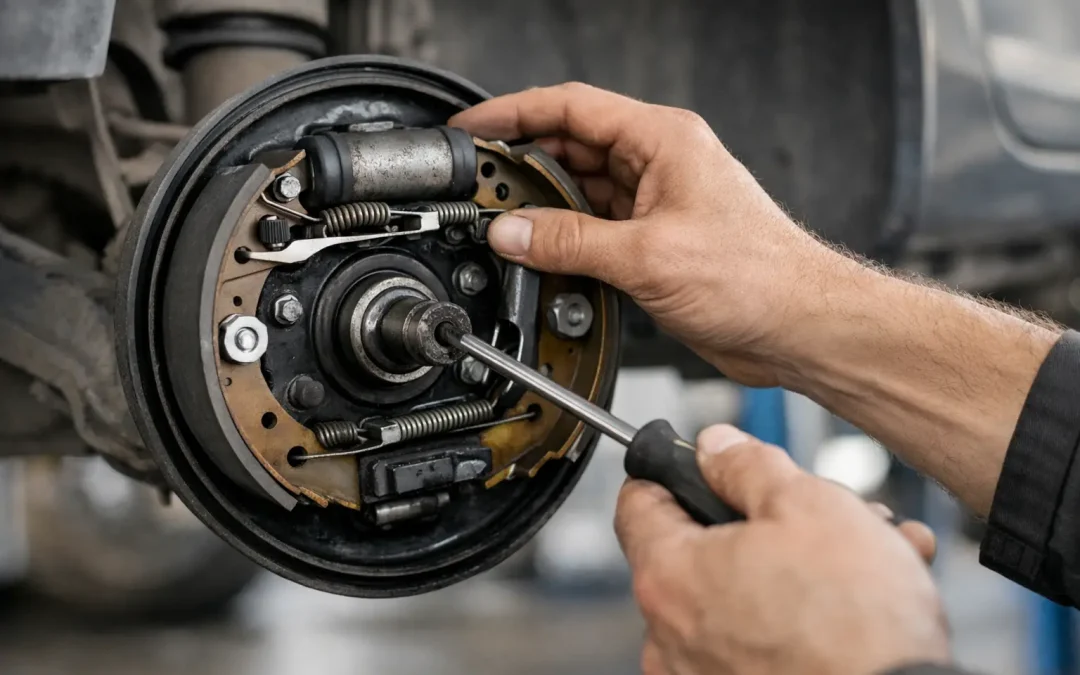
Inside a drum brake, curved brake shoes press outward against the inner surface of a metal drum. As the shoe lining wears, the gap between the shoes and drum increases. Most systems have a self-adjuster designed to take up that clearance during normal use, often when braking in reverse or applying the handbrake.
That system can seize, wear out, be fitted incorrectly or simply fail to keep up with wear. When it does, the shoes must travel farther before they contact the drum. The rear brakes may still work to a degree, but pedal feel, handbrake operation and brake balance can all suffer.
Not every vehicle with a soft pedal has an adjustment problem. Air in hydraulic lines, a fluid leak, worn front pads, a sticking caliper or a master cylinder fault can produce similar symptoms. That is why proper diagnosis matters before anyone starts adjusting components or replacing parts.
Common rear drum brake adjustment symptoms
A low or long brake pedal
A brake pedal that travels farther than it used to before the vehicle begins to slow is one of the most common signs. Excess clearance at the rear shoes means hydraulic pressure first has to move the shoes across that gap. The pedal may feel better if you pump it once or twice, although pumping can also point to other faults.
Do not assume a low pedal is normal because the vehicle still stops. Brake response should be predictable every time, particularly in wet conditions, traffic or while towing.
A handbrake that pulls too high
If the handbrake lever or pedal needs far more travel than usual before it holds the car, rear shoe adjustment is worth checking. On many drum-brake setups, the service brakes and handbrake operate the same shoes. Too much shoe-to-drum clearance means the handbrake cable has to pull farther as well.
A stretched cable can cause a similar issue, so tightening the cable alone is not always the right repair. If the shoes are badly out of adjustment, cable adjustment can mask the fault without restoring correct brake operation.
Weak braking from the rear
Rear brakes generally do less work than the fronts under heavy braking because weight transfers forward. Even so, they play an essential role in stable, balanced stopping. When rear drums are poorly adjusted, the fronts may be forced to do more than their share.
Drivers may notice the car feels less settled under brakes, especially with passengers, luggage or a loaded ute tray. For towing vehicles, weak rear braking can be more noticeable because the vehicle is carrying greater load and needs predictable control downhill.
Brake imbalance or pulling
If one rear drum is adjusted differently from the other, the vehicle can brake unevenly. A pull to one side may be felt during braking, although it can also be caused by front brake issues, tyre problems or suspension faults.
Uneven braking is not a fault to diagnose by road-testing aggressively. A workshop can assess brake balance safely and inspect both sides for seized adjusters, contaminated linings, leaking wheel cylinders and uneven wear.
Scraping, grabbing or a change after reversing
Some self-adjusters work when the vehicle is braked while reversing. If the pedal or handbrake feel changes after a few reverse stops, the adjusters may be partly working. Repeated clicks, scraping, grabbing or a harsh feel can suggest worn hardware, damaged drums or shoes that are not moving freely.
Noise alone does not prove an adjustment issue. Dust, rust on the drum surface, glazed linings and loose hardware can all make themselves heard. The important part is the change from normal behaviour.
Poor results at inspection or a loaded brake test
For work vehicles and trailers, a brake imbalance or weak parking brake may show up during an inspection or test before the driver has noticed a major issue. This is useful warning, not paperwork to ignore. Brake performance can deteriorate slowly enough that it becomes obvious only when measured.
Why drum brake adjustment goes wrong
Normal lining wear is the starting point, but the adjustment mechanism itself is often the real issue. Drum brakes operate in a hot, dusty environment, and components can corrode or bind over time. Vehicles that do short trips, sit for long periods or see mud, water crossings and dirt roads can be more prone to seized hardware.
Incorrect previous repairs are another possibility. Shoe return springs, adjusters and handbrake levers need to be installed in the correct position. Using poor-quality hardware or reusing tired springs can lead to uneven movement and premature trouble.
A leaking rear wheel cylinder needs prompt attention. Brake fluid can soak into the linings, reducing friction and damaging the shoes. In that situation, adjustment is only part of the job. The leak must be repaired, contaminated components replaced and the hydraulic system bled correctly.
Drums also wear. Their internal diameter increases as material is removed through wear or machining. Once a drum exceeds its maximum allowable diameter, it cannot be safely reused. Fitting new shoes to an out-of-spec drum may provide a short-term improvement but not a repair built to last.
Can you adjust rear drum brakes yourself?
Some drum brake systems have an inspection slot that allows adjustment without removing the drum. Others need to be stripped for inspection before any adjustment can be done properly. The process may sound simple, but there is a fine line between excessive clearance and brakes adjusted too tight.
Over-adjusted shoes can drag on the drum, creating heat, rapid wear, poor fuel economy and a burning smell. Under-adjusted shoes leave you with the original long-pedal problem. More importantly, external adjustment cannot reveal a leaking wheel cylinder, cracked lining, damaged springs or a drum that is worn beyond limits.
If you have the correct workshop information, lifting equipment and experience, a basic adjustment may be within reach. For most drivers, particularly where pedal feel has changed noticeably or the handbrake is unreliable, an inspection is the safer call. Brakes are not the place for guesswork.
What a proper drum brake inspection should cover
A worthwhile brake check goes beyond winding an adjuster until the wheel drags. The wheel and drum should be removed so the condition of the components can be assessed. A technician should inspect shoe lining thickness and wear pattern, the drum surface and diameter, wheel cylinders for leaks, return springs and retaining hardware, adjuster operation, handbrake cables and the hydraulic system.
The shoes are then adjusted to the correct clearance, the drum is refitted and the brake pedal and handbrake are checked. Where parts are worn or contaminated, replacing them as a matched set on the axle helps maintain even braking. Quality components matter here, because cheap brake parts can create noise, poor fitment and shorter service life.
At Albury Brake and Clutch Centre, the focus is on finding the reason for the symptom first, then recommending only the work needed to restore safe, reliable braking. That may be a clean and adjustment, or it may be shoes, drums, wheel cylinders and hardware where the condition calls for it.
When to stop driving and book a brake check
Do not keep driving if the brake warning light is on, the pedal feels spongy or suddenly sinks, brake fluid is low, the vehicle pulls sharply, or you smell hot brakes after a normal drive. These signs can indicate a hydraulic failure, seized component or dragging brake rather than a routine adjustment issue.
For less urgent changes, book an inspection soon if your handbrake has excessive travel, the pedal is lower than normal, braking feels uneven or the car has not had its rear drums checked for some time. This is particularly sensible before a towing trip, a long holiday drive or carrying heavier loads.
Your brakes should feel consistent, hold securely when parked and give you confidence at every set of lights. If they do not, a proper inspection now is usually cheaper and safer than waiting for a minor adjustment issue to turn into damaged drums, contaminated shoes or a roadside problem.