


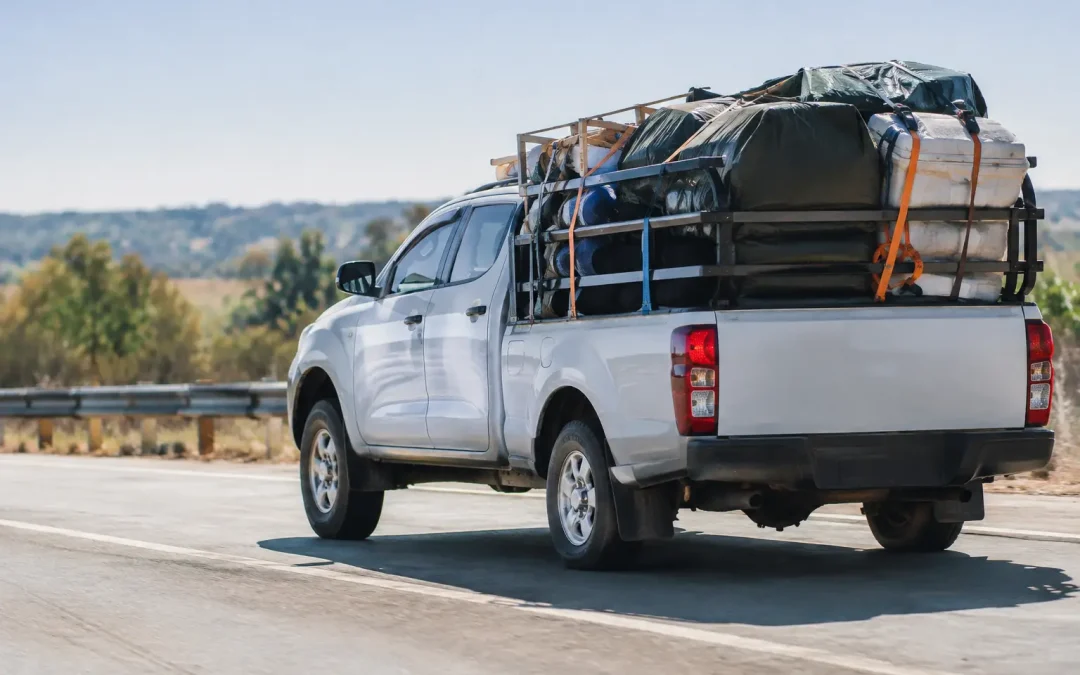
A real overloaded ute stopping example is less about a dramatic emergency stop and more about the small margin that disappears when a ute is carrying too much. The brakes may still feel normal around town, but add tools, passengers, a canopy, tow ball weight and a loaded trailer, and the vehicle has far more weight to control when something goes wrong.
For ute owners who work, tow or tour around Albury Wodonga, payload is not just a number on a spec sheet. It affects how the vehicle sits on the road, how quickly it responds, how hard the brakes have to work and whether it remains stable under heavy braking. A ute that is overloaded, or loaded poorly, can turn an avoidable situation into a serious one.
An overloaded ute stopping example
Consider a dual-cab ute with a gross vehicle mass, or GVM, of 3,200 kg. Its available payload is 1,000 kg. That sounds like plenty until the accessories and people are counted.
The driver and passenger add 160 kg. A canopy, drawer system and roof rack add another 180 kg. Tools and recovery gear contribute 250 kg, while a fridge, food, water and camping equipment add 130 kg. Put 280 kg of tow ball weight onto the vehicle and the total payload is already 1,000 kg.
There is no capacity left for extra passengers, a full load of materials or the gear that often gets thrown in at the last minute. Add 150 kg of supplies in the tray and the ute is now 150 kg over its GVM. It may not look dramatically overloaded, but it is beyond the manufacturer’s designed operating limit.
Now picture that ute travelling at 100 km/h. Before the driver even touches the brake pedal, a typical reaction time of 1.5 seconds means the vehicle travels roughly 42 metres. That distance does not change because the ute is heavier. What changes is the braking phase after the pedal is applied.
There is no honest single figure for how many extra metres an overloaded ute will need to stop. Road surface, tyre condition, brake temperature, suspension setup, load placement and the severity of braking all matter. But the added mass means more energy has to be controlled. At the same speed, a vehicle weighing 3,200 kg carries about 45 per cent more kinetic energy than one weighing 2,200 kg. The brakes, tyres and suspension must manage that extra load while keeping the vehicle straight and stable.
That is where the risk sits. The pedal may feel firm, yet the ute can take longer to pull up, squat heavily at the front, become unsettled over bumps or lose rear-wheel grip. If the tray load is too far behind the rear axle, steering response can become lighter just when the driver needs it most.
Why weight affects more than stopping distance
Braking is not simply a matter of fitting bigger brake pads and assuming the problem is solved. During hard braking, weight transfers forward. The front brakes do most of the work, while the rear axle becomes lighter. A ute carrying excess weight in the rear can react differently again, particularly if the rear suspension is sagging or the load is not secured close to the cab.
Modern ABS and stability control are valuable safety systems, but they cannot repeal physics. They can help prevent wheel lock-up and assist the driver in a loss-of-control event. They cannot make an overloaded vehicle legal, restore lost payload capacity or compensate for tyres that are overloaded or underinflated.
Towing adds another layer. Tow ball weight counts as payload and is carried behind the rear axle. It can put substantial load onto the rear suspension and tyres while also reducing weight on the front axle. That may make steering feel vague and increase the chance of instability when braking downhill, in crosswinds or on uneven regional roads.
A trailer with properly functioning brakes helps, but it does not remove the need to keep the ute within its limits. The vehicle still has GVM, gross combination mass, axle rating and tow ball limits to consider. The lowest applicable rating is the limit that matters.
The brake problems that heavy utes expose
A loaded ute does not always have faulty brakes. Often, it has brakes that are being asked to do more than the vehicle’s original setup was designed to handle repeatedly. This is particularly common with touring 4x4s running larger tyres, upgraded GVM packages or regular towing loads.
Brake fade is one concern. Repeated braking, especially on long descents or in stop-start traffic with a loaded vehicle, creates heat. As temperatures rise, pedal feel can change and braking performance can reduce. Cheap or unsuitable pads may also create more noise, dust or uneven wear under these conditions.
Tyres are equally critical. They are the only contact between the vehicle and the road. A tyre can have legal tread depth and still be a poor choice for the actual axle load, speed and road conditions. Incorrect pressures can make matters worse. Underinflated tyres run hotter and feel less precise, while pressures that are too high for the conditions can reduce the contact patch and ride quality.
Suspension condition also plays a part. Worn shocks, tired springs and poor load distribution allow more body movement under braking. That movement reduces driver confidence and can make a heavy vehicle harder to place accurately on the road.
Check the numbers before the next big load
The most useful step is to weigh the ute as it is actually used. Do not rely on an empty tray and a brochure payload figure. Load the accessories, people, tools, fuel, recovery gear and towing equipment that normally travel with the vehicle, then use a public weighbridge.
Check total vehicle mass, front axle mass and rear axle mass. A ute can be under GVM but still exceed an individual axle rating, especially with a heavy tray load or tow ball weight. Confirm the tyre load ratings and pressures are suitable for the measured axle loads, not just the vehicle model.
Also check the compliance plate and manufacturer information for GVM, gross combination mass, front and rear axle limits, maximum braked towing capacity and maximum tow ball download. These figures are connected, but they are not interchangeable. A claimed towing capacity does not mean every combination of passengers, accessories and trailer load is permitted.
If the ute has a GVM upgrade, larger tyres or aftermarket suspension, make sure the setup is compliant and that the ratings you are using reflect the approved configuration. Modifications can improve capability, but only when they are selected and fitted properly.
When a brake inspection is worth booking
Do not wait for a warning light or grinding noise if the ute regularly carries weight. A proper brake inspection is sensible before a major towing trip, after fitting larger tyres, when adding a canopy and drawers, or if the vehicle has started to pull, shudder, fade or feel less settled under brakes.
A specialist inspection should look beyond pad thickness. It should assess rotor condition, pad material, caliper operation, brake fluid condition, hoses, tyre wear and the way the vehicle is being used. For some 4x4s, a quality brake upgrade may be worthwhile. For others, standard-size components in the right specification, fitted correctly and serviced on time, are the better answer.
That distinction matters. There is no value in selling parts a vehicle does not need. The right repair or upgrade depends on the ute’s weight, tyre size, towing habits and the roads it travels.
At Albury Brake and Clutch Centre, heavy-duty ute and 4×4 brake work starts with those practical questions. The aim is straightforward: identify what is actually limiting the vehicle, use quality components and give you a clear answer without pressure.
A ute should be loaded with the same care used to choose its brakes. Keep weight within the ratings, place heavy items low and forward where practical, secure the load properly and have the braking system checked before the next hard-working trip. That gives you more than compliance – it gives you more room to respond when the road does not go to plan.