


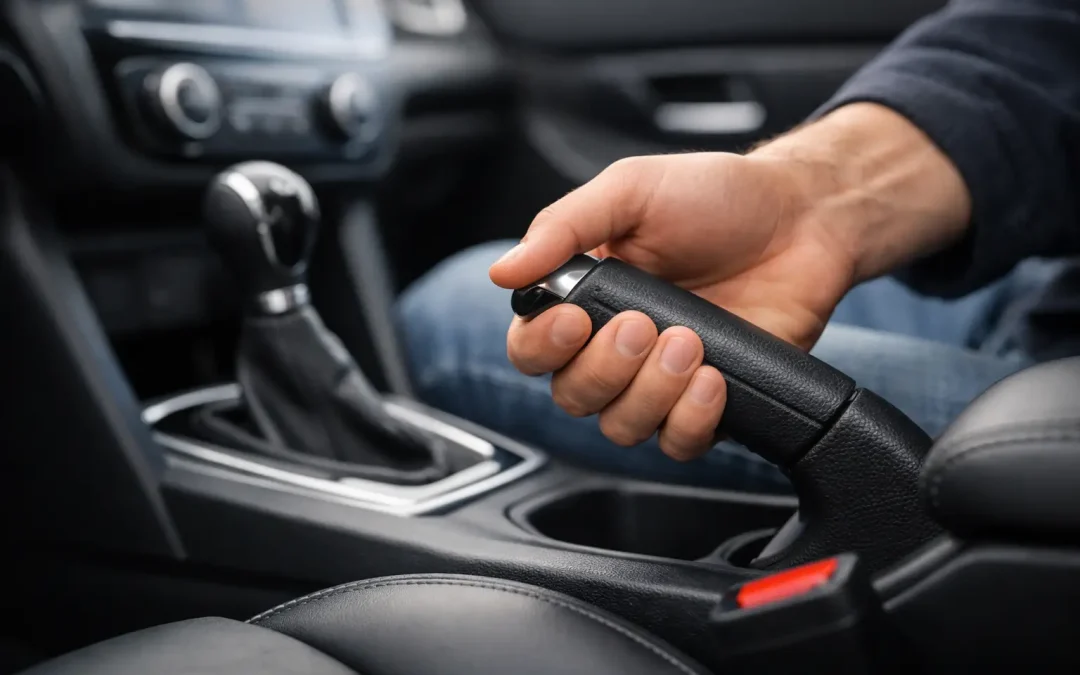
A handbrake that feels normal in the driveway can still be doing very little when it matters. Knowing how to check handbrake operation gives you a useful early warning, particularly if you park on a slope, tow a trailer, drive a 4×4 or rely on your vehicle every day around Albury Wodonga.
Your handbrake, also called the parking brake, is there to hold a stationary vehicle securely. It is not a substitute for selecting Park in an automatic or leaving a manual in gear, but it should provide a firm, reliable hold on its own. If it does not, the fault needs proper attention rather than a quick adjustment and hope for the best.
What a healthy handbrake should feel like
In a conventional lever-operated system, the handbrake should engage smoothly and become firm after a reasonable number of clicks. There is no universal ‘correct’ number because cable adjustment, rear brake design and vehicle specifications differ. What matters is that it does not pull all the way to the top of its travel, feel loose, or need excessive force before it starts holding.
When released, the lever should return fully and the brake warning light should go out. The vehicle should then roll freely without a dragging sensation, hot brake smell or one rear wheel becoming unusually warm after a short drive.
Electronic parking brakes work differently. Most use a switch and electric actuators at the rear brakes, and may apply automatically when the vehicle is switched off. You should hear the system operate, see the warning light change as expected and feel the vehicle remain secure. If there is a warning message, repeated clicking, slow operation or a failure to release, do not ignore it.
How to check handbrake operation safely
A simple check can be done at home, but choose a safe location. Use level, firm ground with plenty of clear space around the vehicle. Keep people, pets and obstacles away, and never test a handbrake by applying it while driving.
Start with the engine running if your vehicle requires this for normal brake system operation. Keep your foot firmly on the service brake, select neutral for a manual or Park for an automatic, then apply the handbrake fully. For an electronic unit, follow the procedure in the owner’s manual.
With the handbrake applied, release the foot brake gradually and check that the vehicle stays put. On level ground, this confirms the basic holding function, but it does not prove the system will hold safely on a steep driveway or with a loaded vehicle.
If you have access to a mild, clear slope, a more meaningful check can be made with care. Stop facing uphill or downhill, keep your foot brake applied, select neutral where appropriate and apply the handbrake firmly. Release the foot brake slowly. The car should remain stationary without rolling or needing you to keep pressure on the pedal.
Do not use a steep hill, a busy street or an area where a roll-away could cause damage. Do not stand outside the vehicle while conducting the check. If the car creeps, rolls, or only holds with the lever pulled exceptionally high, put it back in gear or Park and arrange an inspection.
For a manual vehicle, leave it in first gear when facing uphill and reverse when facing downhill after parking. For an automatic, select Park. These are sensible additional safeguards, not a reason to accept a weak handbrake.
Check the release as well as the hold
A parking brake can have the opposite problem: it applies but does not release properly. After your test, fully release the lever or switch, then drive a short distance normally. Pay attention to whether the car feels reluctant to move, pulls to one side, or seems to use more throttle than usual.
A hot or burning smell from the rear of the car, smoke, reduced fuel economy or a wheel that is noticeably hotter than the others can point to dragging brakes. Stop driving if you suspect a brake is binding. Continued driving can overheat pads, shoes, discs, drums and wheel bearings, turning a smaller repair into a more expensive one.
Signs your handbrake needs attention
A change in operation is usually more useful than fixating on one symptom. If your handbrake used to hold halfway through its travel and now comes close to the end, something has changed. It may be cable stretch, worn rear brake components, a seized mechanism or incorrect adjustment.
Book an inspection if you notice any of the following:
- The vehicle rolls or creeps when parked with the handbrake fully applied.
- The lever pulls too high, feels loose, sticks, or will not release cleanly.
- The brake warning light stays on or an electronic parking brake warning appears.
- You hear grinding, scraping, clicking or straining from the rear brakes.
- A rear brake drags, overheats or produces a burning smell.
- The handbrake performance changed after rear brake work, deep water crossings or extended off-road driving.
For utes and 4x4s used for towing, loaded touring or larger-tyre and GVM setups, a reliable parking brake deserves extra attention. More weight and steeper campsites place more demand on the system. A handbrake that is only just adequate when the vehicle is empty may not provide enough margin when a caravan is connected or the tray is loaded.
Why adjustment is not always the answer
It is tempting to think every loose handbrake simply needs tightening. Sometimes that is true, but adjustment alone can hide the real cause.
On many vehicles, the parking brake works through the rear service brakes. Depending on the design, it may operate rear brake shoes inside a drum, use a small drum arrangement inside the rear disc, or mechanically actuate the rear caliper. Worn shoes or pads, seized caliper levers, corroded cables, damaged hardware and contaminated components can all affect holding power.
Tightening a cable against worn or poorly operating components may make the lever feel better without restoring safe braking performance. It can also leave the brakes dragging when released. That is why a proper diagnosis checks the condition and movement of the entire system before any adjustment is made.
Electronic parking brakes add another layer. They can require scan-tool procedures to place the system into service mode, retract actuators correctly and clear fault codes after repair. Forcing components or trying to wind them back without the right process can damage the actuator or caliper.
What a proper workshop inspection involves
A specialist inspection starts with the concern you have noticed: poor hold, excessive travel, warning lights, sticking or noise. The technician should then assess the parking brake’s holding ability, cable or actuator movement, rear brake wear, discs or drums, calipers, shoes, pads and related hardware.
The system is checked for seized parts, corrosion, leaks where relevant and signs of overheating. If repairs are needed, the goal is not merely to get the light off or make the lever feel tighter. It is to restore reliable operation with quality components and confirm the brake applies and releases as it should.
At Albury Brake and Clutch Centre, that means straight answers about what has failed, what is worn and what can reasonably wait. Parking brake repairs are safety work, so the right fix depends on the vehicle’s brake design and condition – not a one-size-fits-all adjustment.
Do not wait for the next steep driveway
A weak handbrake often gives warning before it becomes a serious problem. Check it periodically, particularly before a towing trip, after rear brake repairs or if your vehicle has spent time in mud, water or rough country. A few minutes of careful checking can identify a change early.
If it will not hold securely, will not release cleanly or brings up a warning light, park on level ground where possible and have it inspected. A parking brake should give you confidence when you leave the driver’s seat, not another thing to worry about.