


Your brake fluid sits out of sight, but it does one of the most important jobs on the vehicle. When you press the brake pedal, it transfers that force to the braking system. Knowing how to tell brake fluid is contaminated can help you deal with a developing problem before it affects pedal feel, stopping performance or expensive hydraulic components.
The tricky part is that contaminated brake fluid does not always cause an obvious warning light or dramatic symptom. A vehicle can still stop reasonably well while its fluid is holding too much moisture, carrying debris or breaking down from age. That is why a proper inspection matters, particularly if the service history is unclear, the vehicle tows regularly or it is used on long regional runs.
What contaminated brake fluid actually means
Brake fluid is designed to work under high pressure and high temperature. Most passenger vehicles use glycol-based DOT 3, DOT 4 or DOT 5.1 fluid. These fluids are hygroscopic, meaning they gradually absorb moisture from the air over time.
A small amount of moisture is normal as fluid ages. Too much is the problem. Water lowers the fluid’s boiling point and can encourage corrosion inside brake lines, calipers, wheel cylinders and the ABS hydraulic unit. Under repeated hard braking, such as towing a caravan down a long descent, moisture-contaminated fluid can boil. Vapour compresses far more easily than fluid, which can leave the pedal feeling soft or travelling further than it should.
Contamination can also mean dirt, rubber particles from deteriorating seals, metal debris, incorrect fluid or petroleum-based liquid entering the system. These issues are less common than moisture contamination, but they are more urgent and should not be treated as a simple fluid change.
How to tell if brake fluid is contaminated
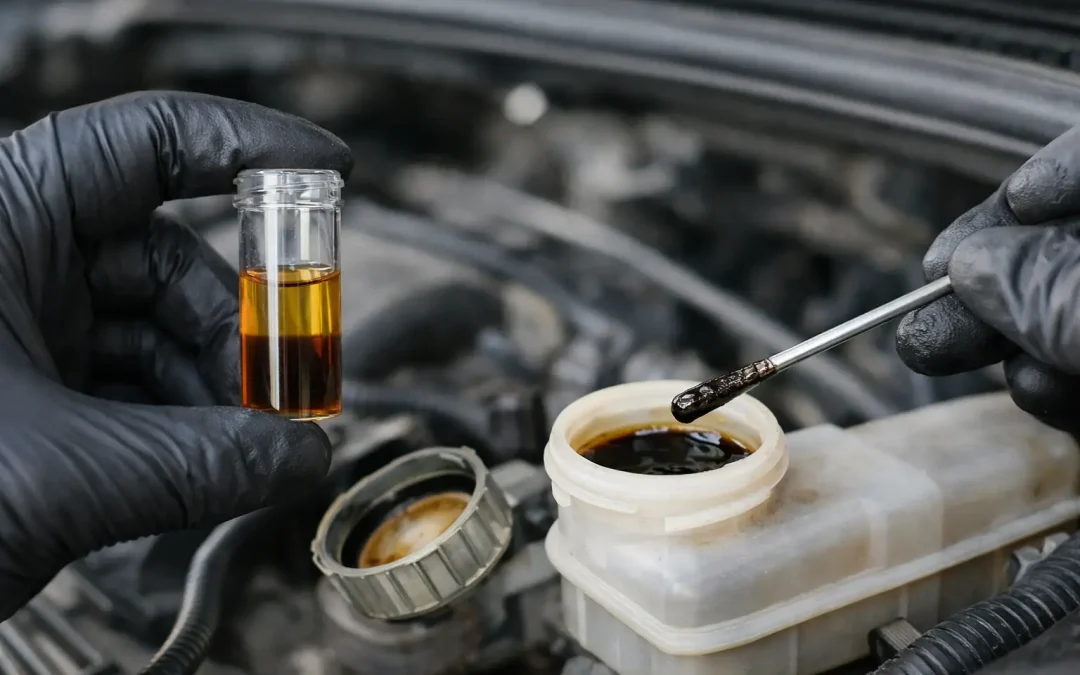
Colour is often the first thing people look for. Fresh brake fluid is commonly clear to pale amber. Fluid that is dark brown, grey or nearly black is overdue for attention, especially when compared with fresh fluid of the correct specification.
But colour alone is not a reliable diagnosis. Some fluid darkens naturally with age, while fluid can look relatively clean in the reservoir yet be more degraded in the calipers and lines. The reservoir is only one part of the system. A specialist checks the fluid condition as well as the condition of the brakes themselves.
A cloudy appearance, floating particles, sludge around the reservoir, or visible sediment are stronger warning signs. They can point to moisture, debris or deterioration within the hydraulic system. Never wipe debris into the reservoir or top it up with an unknown fluid just to make it look better.
A workshop can test the fluid more accurately. Electronic testers estimate moisture content by measuring electrical conductivity. They are useful as a guide, although results can vary with fluid type and tester quality. A boiling-point test provides a more direct indication of whether the fluid still has a safe temperature margin. The right test depends on the vehicle, the type of fluid specified and what the inspection finds.
Pedal feel can offer a clue, but it is not proof
A soft, spongy or inconsistent brake pedal deserves attention. Contaminated fluid can contribute to this feeling, but so can air in the system, a brake fluid leak, worn components, a failing master cylinder or an ABS fault. It needs proper diagnosis rather than an assumption that a flush will solve everything.
If the pedal slowly sinks while steady pressure is held, the vehicle pulls when braking, or the brake warning light comes on, arrange an inspection promptly. If braking performance suddenly drops, the pedal goes close to the floor, or there is an obvious leak, do not keep driving it. Have the vehicle recovered and checked.
Check the service history, not just the reservoir
For many vehicles, brake fluid replacement is recommended every two years. Some manufacturers specify a different interval, so the vehicle handbook and service schedule should come first. Time matters even when kilometres are low because moisture absorption is age-related, not just distance-related.
A car that has spent years doing short trips may still need a fluid change on schedule. Likewise, a 4×4 used for towing, touring or carrying increased loads may place more heat into its brakes than a lightly used commuter car. In those conditions, staying ahead of the scheduled fluid replacement is sensible preventative maintenance.
Signs that need urgent attention
Brake fluid contamination is not always an emergency, but a few signs should move the job to the top of the list. These include a burning smell after braking, smoke from a wheel, a sudden change in pedal feel after a steep descent, or fluid that looks milky or contains obvious particles.
Fluid level is also worth checking, but it needs context. A gradually lowering level can be caused by brake pad wear because the caliper pistons sit further out as pads wear down. It can also indicate a leak. Do not simply top up the reservoir and forget about it. Find out why the level changed.
If the fluid has an oily appearance or smells unlike normal brake fluid, stop and get advice before driving. Engine oil, power steering fluid, transmission fluid and other petroleum products can damage brake-system rubber seals. In serious cases, affected hydraulic components may need replacement. Flushing alone may not be enough, and delaying repairs can make the job larger and less safe.
What a proper brake fluid service involves
A proper brake fluid service is more than removing fluid from the reservoir and adding fresh fluid on top. Old fluid remains in the lines, calipers, wheel cylinders and, depending on the vehicle, the ABS hydraulic unit. Those areas need to be flushed through correctly.
The process begins with confirming the correct fluid specification. DOT ratings are not interchangeable by default, and silicone-based DOT 5 fluid is particularly different from common glycol-based fluids. Using the wrong product can cause compatibility problems or leave the system below the manufacturer’s requirements.
The technician then checks for leaks, damaged hoses, uneven pad wear, seized caliper slides and other faults that can affect braking. Fresh, correct-specification fluid is used to flush old fluid from each brake circuit until the system is clear and properly bled. The pedal is checked afterwards, and the vehicle is road-tested where appropriate.
On some modern vehicles, a scan tool procedure may be needed to cycle valves in the ABS system or complete a thorough bleed. This is one reason a quick driveway fluid swap can be a false economy. Brakes are safety-critical, and getting trapped air or incorrect fluid into the system creates risks that are not worth taking.
Can you inspect brake fluid yourself?
You can make a basic visual check safely with the vehicle parked on level ground and the engine off. Find the brake fluid reservoir, usually near the back of the engine bay on the driver’s side, and look through the plastic body where possible. Check the level against the minimum and maximum markings and look for unusually dark, cloudy or dirty fluid.
Avoid opening the cap unless necessary. Brake fluid absorbs moisture once exposed to air, and dirt can enter easily. Do not use a random bottle from the shed, reuse old fluid or mix products because the label sounds similar. Brake fluid can also damage paint, so any spill should be dealt with carefully and promptly.
A visual check is useful for spotting concerns. It cannot confirm moisture content, boiling point or internal corrosion. If you are unsure, a brake inspection gives you a straight answer without guessing.
When to book a brake fluid check
Book a check if your fluid is dark or cloudy, the vehicle is due for its scheduled brake fluid replacement, the pedal feels different, or you have recently bought a used vehicle with incomplete service records. It is also worthwhile before a major towing trip or after hard-use touring where brakes have been working under sustained heat.
At Albury Brake and Clutch Centre, the focus is on finding the actual cause, using the right fluid and parts, and explaining what is needed without pressure. A brake fluid flush may be all that is required, or an inspection may uncover another issue that needs attention first.
Brake fluid is inexpensive compared with the components it protects. Keeping it clean, correctly specified and changed at the right interval is one of the simplest ways to look after the braking system that looks after you.