


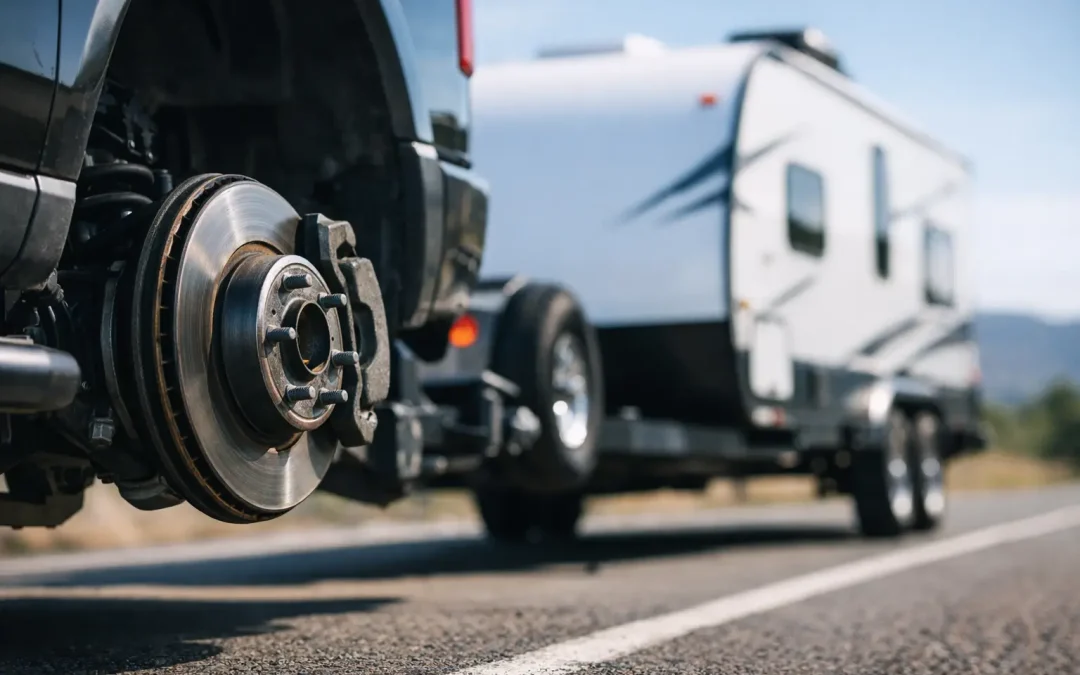
Hooking up the camper, car trailer or work trailer changes far more than your vehicle’s fuel use. So, does towing wear brakes? Yes – towing can wear brakes faster, sometimes much faster, because your vehicle has more weight and momentum to control every time you slow down or stop.
That does not mean towing should automatically ruin a healthy brake system. A correctly matched trailer, sensible loading, good driving habits and brakes that are properly maintained can handle regular towing safely. Problems start when the tow vehicle is pushed beyond what its braking system can comfortably manage, or early warning signs are ignored.
Does towing wear brakes faster?
Your brakes turn movement into heat. The heavier the combined vehicle and trailer, the more heat they must absorb. At suburban speeds this may not be dramatic, but a long downhill run, repeated stop-start traffic, a loaded 4×4 or a steep boat ramp can expose weaknesses quickly.
Brake pads and rotors are wear items, so some wear is expected. Towing increases the workload on both. It can also heat brake fluid, stress calipers and reveal components that were already sticking, worn or poorly matched to the vehicle’s current setup.
The effect depends on the vehicle, trailer weight, terrain and how you drive. A lightly loaded box trailer used occasionally on flat roads is very different from a caravan or tandem trailer behind a fully loaded 4×4 on a touring trip. Larger tyres, increased GVM and extra touring gear also add weight and rotational mass that the brakes need to control.
Why towing puts more load on your brakes
When you brake without a trailer, your vehicle’s brakes only need to slow the vehicle itself. With a trailer attached, the tow vehicle may be dealing with several additional tonnes of moving mass. Even where the trailer has electric or hydraulic brakes, the tow vehicle still carries a significant share of the work.
The challenge is not just the total weight. Momentum rises sharply with speed. A loaded rig travelling at 100 km/h needs much more stopping effort than one travelling at 80 km/h. Leave a bigger gap, brake earlier and avoid relying on a last-minute hard stop.
Heat is the main enemy. Brake pads work best within a certain temperature range. Excessive heat can cause brake fade, where the pedal may still feel firm but the vehicle does not slow as effectively as it should. Rotors can develop heat spots or distort, pads can glaze, and brake fluid can boil in severe cases. None of these are faults to gamble on when you have a trailer behind you.
Trailer brakes matter, but they need to be set up correctly
A braked trailer is not a substitute for maintaining the tow vehicle’s brakes. It is part of the overall braking system. Electric trailer brakes need a correctly installed controller, suitable wiring and adjustment that matches the load and road conditions.
If the controller gain is set too low, the vehicle brakes do too much of the work. Set it too high and the trailer can grab or lock its wheels, particularly on loose surfaces or in the wet. Trailer brakes, bearings, tyres and breakaway equipment also need regular inspection. A trailer that is technically braked but poorly maintained will not provide the safety margin you expect.
The situations that cause the most brake wear
Long descents are hard on brakes because the vehicle is constantly fighting gravity. The answer is not to ride the brake pedal all the way down. Select a lower gear before the descent so the engine helps hold your speed. Automatic vehicles may have manual shift, sport or tow/haul modes that allow more engine braking. Use them where appropriate.
Stop-start driving also adds up. Towing through town, approaching busy holiday traffic or manoeuvring around boat ramps means repeated low-speed braking with little time for components to cool. A heavy trailer in these conditions can wear pads quickly, especially if the trailer brake controller is not doing its share.
Overloading is another common cause. Gross combination mass, towball download, axle limits and the trailer’s rated capacity all matter. Weight distribution matters too. Excess weight at the rear of the trailer can cause sway, while too much ball weight can overload the rear axle and affect steering and braking balance. Staying within a tow rating is not just about whether the vehicle can pull the load – it must be able to stop it safely.
Warning signs your brakes need attention
Do not wait for a brake warning light before arranging an inspection. Many brake issues give practical warning signs well beforehand. If you tow regularly, pay attention to changes after a trip, not just during normal solo driving.
A brake check is worthwhile if you notice any of the following:
- A longer stopping distance, a soft pedal or a pedal that feels different under load.
- Vibration through the steering wheel or brake pedal when slowing down.
- Pulling to one side, a dragging feeling or the vehicle wandering under brakes.
- Squealing, grinding or a hot, burning smell near a wheel after driving.
- A brake warning light, low fluid level or visible leaks around wheels or brake lines.
- Trailer brakes that grab, lock up, fail to respond consistently or feel noticeably weak.
Some noises are not immediately dangerous, but grinding, smoke, a severe pull or a sudden change in pedal feel should be treated as urgent. Pull over safely and do not continue towing until the issue has been assessed.
How to reduce brake wear when towing
Good towing technique makes a genuine difference. Start by giving yourself more room. Increase following distance, look further ahead and slow down early rather than braking hard at the last moment. This keeps temperatures lower and gives the trailer more time to settle behind the vehicle.
On hills, use the gearbox as well as the brakes. Select a lower gear before the downhill section, not after the vehicle has already picked up speed. Brief, controlled braking to bring speed back under control is better than holding steady pressure on the pedal for kilometres.
Keep the rig within its limits and load the trailer properly. Check tyre pressures on both vehicle and trailer before leaving, including the spare. Underinflated tyres can make a rig feel unstable and contribute to poor handling, which often leads to more abrupt braking.
For regular towing, consider whether the standard braking setup still suits the vehicle. A 4×4 with larger tyres, extra accessories, increased GVM and a caravan may benefit from a heavy-duty brake upgrade. The right pads, rotors and components are selected for the vehicle’s actual use, not simply because they are advertised as the biggest or most aggressive option.
When a brake inspection is worth booking
There is no single kilometre interval that suits every towing vehicle. Pad life can vary widely depending on the load, the roads and the driver. A vehicle that mostly does highway kilometres may show little wear, while the same model used for frequent towing around hills or traffic may need attention much sooner.
It makes sense to have the brakes inspected before a major towing trip, after a long holiday run, or whenever you have noticed a change in performance. A proper inspection should look beyond pad thickness. Rotors, calipers, brake fluid condition, hoses, hardware and the overall condition of the trailer braking system can all affect stopping performance.
At Albury Brake and Clutch Centre, the focus is on finding the cause rather than selling parts that are not needed. If your brakes are still serviceable, you should be told. If they need repair or an upgrade for the loads you tow, the work should be explained clearly and completed with quality components suited to the job.
Towing asks more of your brakes, but it does not have to shorten their life unnecessarily. Keep the load sensible, use the gears on descents, make sure the trailer brakes are working properly, and act early if the vehicle feels different. That is the practical way to protect your brakes – and everyone travelling around you.