


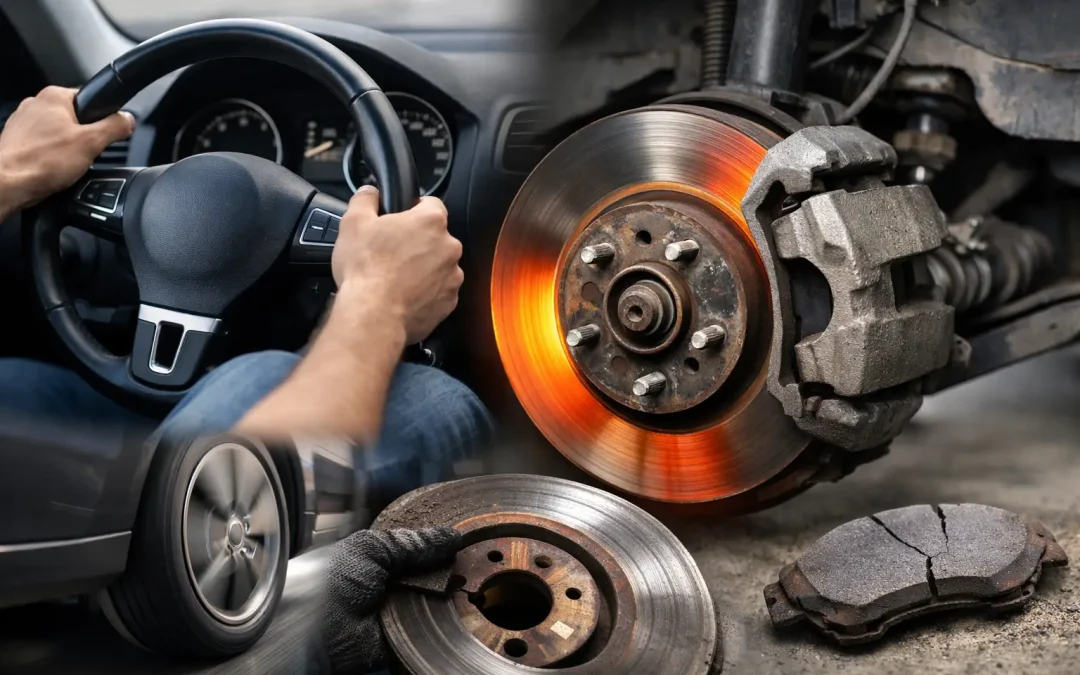
A steering wheel that shudders as you slow for a roundabout, or a brake pedal that pulses under your foot, is not something to ignore. There are five causes of brake vibration we see regularly, and while some are straightforward wear-and-tear issues, others can point to a fault that affects how safely your vehicle stops.
The key is working out when the vibration happens and where you feel it. A shake only under braking needs a different diagnosis from a vibration that is present at highway speed all the time. Replacing parts without checking the cause can waste money and leave the original problem unresolved.
1. Brake disc thickness variation or run-out
Brake discs need to run true and maintain a consistent thickness across their braking surface. When they do not, the brake pads are pushed in and out as the disc turns. That movement is felt as a pulsing brake pedal, a shudder through the steering wheel, or both.
This is often casually called “warped rotors”, but the cause is not always a bent disc. Heat, uneven pad deposits, corrosion, incorrect wheel-nut tension and a disc that does not sit flat against the hub can all lead to disc run-out or thickness variation over time.
Front disc issues commonly create a vibration through the steering wheel, particularly during moderate to firm braking from higher speeds. Rear brake disc issues are more likely to be felt through the pedal or the seat. The exact symptom varies between vehicles, so a proper measurement is more reliable than guessing.
A technician should inspect disc condition, measure run-out and thickness, and check whether the discs remain within the manufacturer’s minimum specification. Depending on the result, the correct repair may be new discs and pads, or addressing the mounting surface or another underlying issue first.
2. Uneven, glazed or contaminated brake pads
Brake pads are designed to create consistent friction against the disc. If their surface becomes glazed, contaminated with oil or grease, overheated, or worn unevenly, braking can become rough and unpredictable.
Glazing often develops when brakes are repeatedly overheated. This may happen on a vehicle that tows regularly, works hard in hilly country, carries heavy loads, or has larger tyres without suitable brake upgrades. You might notice a hard pedal, reduced stopping confidence, squealing, a burning smell after braking, or vibration when the brakes are applied.
Pad material can also transfer unevenly onto the disc face. The result can feel very similar to a disc problem, even when the disc is not physically distorted. Simply fitting a new set of pads without checking the disc surface and caliper operation may only provide a short-term improvement.
Quality pads matched to the vehicle and its use matter. A family SUV used for school runs has different requirements from a 4×4 set up for towing a caravan or touring with a full load. The right components should suit the work the vehicle actually does, not just what is cheapest on the shelf.
3. A sticking brake caliper or worn caliper slides
A brake caliper must apply pressure evenly and release cleanly after you take your foot off the pedal. If a caliper piston is sticking, a flexible brake hose is restricted, or the caliper slide pins are seized, one pad may stay in contact with the disc.
That constant contact creates excess heat. Over time, it can damage the pad, create uneven disc wear and bring on brake vibration. It can also make the vehicle pull to one side under braking, reduce fuel economy, or leave one wheel noticeably hotter than the others after a normal drive.
Do not test wheel temperature by touching brakes directly. They can become hot enough to cause a serious burn. A sharp hot-brake smell, smoke near a wheel, a pulling sensation or a vehicle that does not roll freely are all good reasons to have it checked promptly.
A proper repair is more than pushing the piston back and fitting pads. The caliper, slide hardware, hoses, pad fitment and condition of the disc all need inspection. If a component has caused the failure, it needs to be repaired or replaced so the new parts are not damaged again.
4. Poor disc-to-hub fitment or incorrect wheel-nut tension
The braking system relies on clean, accurate contact between the hub, brake disc and wheel. Rust scale, dirt or damage on the hub face can stop a new disc from sitting perfectly flat. Even a small amount of run-out at installation can become a noticeable brake shudder after a period of driving.
Incorrect wheel-nut tension can cause similar trouble. Tightening wheel nuts unevenly or using an impact gun without a final torque check can place uneven load across the disc and hub assembly. This is particularly relevant after tyre work, puncture repairs or a DIY brake job.
The solution is not to keep replacing discs. The hub face should be cleaned and checked, the disc should be measured once fitted, and wheel nuts should be tightened in the correct sequence to the manufacturer’s specification. It is careful workshop practice, but it makes a real difference to brake life and smoothness.
If vibration returns soon after new brakes have been fitted, installation accuracy should be part of the investigation. Good-quality parts are essential, but they still need to be fitted properly.
5. Tyre, wheel, steering or suspension faults
Not every vibration felt while braking starts in the brake system. Worn suspension bushes, loose steering components, a damaged tyre, an out-of-balance wheel or a worn wheel bearing can all make a braking vibration more obvious.
For example, a worn lower control-arm bush may allow a front wheel to move excessively when braking force is applied. A loose tie-rod end can create instability through the steering wheel. A tyre with a separated belt may cause a thump or shake that is noticeable at speed, then changes character as the vehicle slows.
This is why the timing of the symptom matters. If the steering wheel shakes at 100 km/h even when you are not braking, look beyond the brake discs. If the vehicle tracks poorly, wanders, clunks over bumps or wears tyres unevenly, the steering and suspension deserve close attention as well.
A brake inspection should not stop at the pads and discs when the symptoms suggest a wider problem. Finding the real cause protects your tyres, reduces unnecessary parts replacement and gives you a vehicle that feels stable when you need to stop quickly.
What to do when your brakes vibrate
Brake vibration is a warning sign, not a diagnosis on its own. Make a note of when it occurs: gentle braking or hard braking, low speed or freeway speed, through the pedal or steering wheel, and whether the vehicle pulls left or right. Those details help narrow down the fault quickly.
Avoid putting off an inspection if the vibration is worsening, braking performance has changed, there are grinding noises, a warning light is on, or the vehicle pulls sharply under brakes. If you smell burning, see smoke, or the pedal feels unusually soft, do not continue driving unless it is necessary to get out of immediate danger. Arrange assistance and have the vehicle assessed.
For drivers around Albury-Wodonga, a specialist brake inspection provides straight answers before parts are replaced. At Albury Brake and Clutch Centre, the focus is on checking the complete system, explaining what has failed and why, then completing the repair with components suited to your vehicle and how you use it.
Your brakes should feel smooth, straight and predictable every time you press the pedal. If they do not, getting the cause checked early is usually safer, simpler and more cost-effective than waiting for the vibration to become a larger repair.