


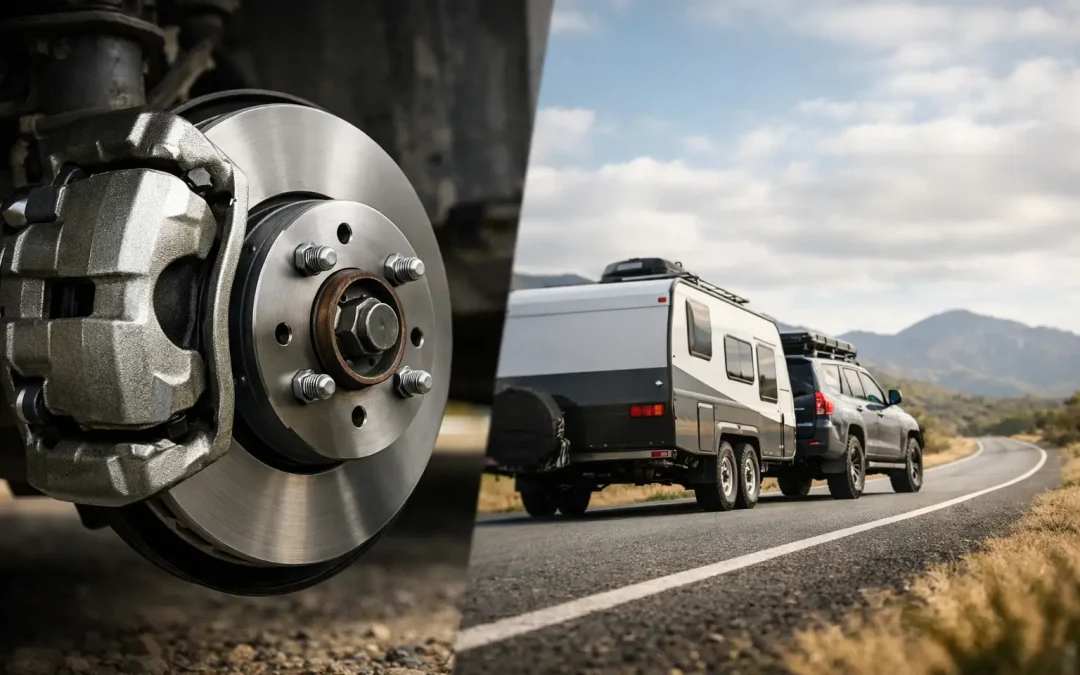
A 4WD can feel perfectly fine on the school run, then tell a very different story with a caravan on the back, a fridge in the rear and a full touring load. This 4WD GVM brake guide explains what changes when your vehicle gets heavier, why brakes need proper attention, and how to make sensible decisions before the next trip.
A GVM upgrade is often part of building a capable touring or work vehicle. It may allow a higher legal vehicle mass when engineered and certified correctly, but it does not make an overloaded or poorly maintained vehicle safe. More weight means more energy for the brakes to manage every time you slow down. Add larger tyres, long descents, a loaded trailer or stop-start traffic, and the margin for worn or under-specced brakes can disappear quickly.
What GVM means for your brakes
GVM, or Gross Vehicle Mass, is the maximum legal weight of the vehicle itself when loaded. That includes the 4WD, passengers, fuel, tools, accessories, recovery gear and tow-ball download. It is not simply a measure of how much gear can fit in the back.
When GVM rises, braking demand rises with it. Your brakes must repeatedly turn the vehicle’s moving energy into heat. A heavier vehicle travelling at the same speed produces more heat during a stop. On a steep descent, or during repeated braking on a winding road, that heat builds up faster than it would in an unladen vehicle.
That is why a well-planned GVM upgrade should prompt a proper conversation about brakes. Suspension upgrades help carry weight and maintain ride height. They do not automatically increase brake capacity. Nor does a set of bigger tyres, a bull bar or an upgraded tow hitch improve your ability to stop.
A brake upgrade may be appropriate, but it depends on the vehicle, the certified mass, tyre size, towing setup and how the 4WD is actually used. There is no one-size-fits-all kit that suits every ute or wagon.
4WD GVM brake guide: start with the real weight
The best starting point is not a catalogue. It is a weighbridge.
Many owners add accessories one at a time and underestimate the combined effect. A canopy, drawers, long-range tank, second battery, fridge, winch, roof-top tent and recovery equipment can consume payload before passengers or luggage are included. A caravan’s tow-ball weight also counts toward the vehicle’s load and can place significant demand on the rear axle.
Weigh the vehicle in touring trim, with the people and gear you normally carry. If you tow, weigh the combination properly as well. This helps establish whether you are within GVM, individual axle ratings, Gross Combination Mass and trailer limits. Staying under one number does not guarantee you are under all the others.
It also gives a brake specialist useful information. A vehicle that only occasionally carries a heavy load may need a high-quality standard replacement setup and careful maintenance. A 4WD regularly towing near its limits through the High Country or across regional roads may benefit from a more substantial brake package designed to shed heat and maintain pedal feel.
Why bigger tyres and towing change the equation
Larger diameter tyres are popular for ground clearance and off-road capability, but they can affect braking performance. They change the effective leverage between the brakes and the road, add rotating mass and may alter the way the vehicle responds under hard braking. The difference is not always obvious in normal suburban driving, which is precisely why it is easy to overlook.
Towing adds another layer. A braked trailer has its own brakes, but the tow vehicle still carries the tow-ball load and must remain stable while controlling the whole combination. Trailer brake controllers need to be correctly adjusted, trailer brakes need servicing, and the vehicle brakes need to be in sound condition. A controller turned up too far can cause trailer wheel lock-up. Set too low, it leaves the 4WD doing too much work.
Brake balance matters as much as outright stopping power. The aim is predictable, controlled braking without pulling, premature wheel lock-up or a soft pedal after a few applications. Quality components and correct fitment matter because braking is a safety-critical system, not a place for shortcuts.
Signs your loaded 4WD needs attention
Do not wait for a brake warning light before arranging an inspection. Some problems show up only when the vehicle is loaded or towing, and by then the parts may already be overheating or wearing unevenly.
Watch for these signs:
- A pedal that feels soft, long or changes after repeated braking.
- Steering pull, vibration or shudder when braking.
- A burning smell, smoke or excessive heat around a wheel after a descent.
- Brake fade, where the vehicle takes more pedal pressure to slow down.
- Squealing, grinding, warning lights or a noticeable drop in stopping confidence.
A hot wheel can also point to a sticking caliper, seized slide, damaged hose or wheel bearing issue rather than just worn pads. Proper diagnosis matters. Replacing pads alone may mask the symptom while leaving the cause in place.
What a sensible brake upgrade looks like
A good upgrade is matched to the job. Depending on the vehicle, that may involve larger or better-designed rotors, quality pads suited to towing and heat, upgraded calipers, brake lines or other components approved for that application. It may also mean returning a neglected factory system to proper condition with premium replacement parts.
The best pad compound is not always the most aggressive one. Some high-performance pads work well at high temperature but can be noisy, dusty or less suitable for cold daily driving. Other pads prioritise quiet operation and low dust but may not hold up as well under repeated heavy towing. The right choice comes from an honest assessment of how the vehicle is used.
Rotor design needs the same common sense. Larger or more thermally efficient rotors can help manage heat, but they must be compatible with the vehicle and any engineering requirements. Drilled or slotted rotors are not automatically better for every 4WD. Build quality, correct sizing, pad match and installation are more important than a flashy appearance.
At Albury Brake and Clutch Centre, the approach is to inspect the full system before recommending parts. That includes pad and rotor condition, caliper operation, fluid condition, hoses, wheel bearings and the way the vehicle is loaded. It is the difference between fitting parts and solving the actual braking problem.
Brake fluid is easy to forget and costly to ignore
Brake fluid absorbs moisture over time. As its boiling point drops, it is more likely to boil under heavy braking, creating vapour in the hydraulic system and a pedal that feels spongy or goes alarmingly long. This is a real concern for loaded 4WDs on long descents.
A brake fluid flush is not an optional extra when the fluid is old or contaminated. It is basic maintenance that protects braking performance and internal components. Follow the vehicle manufacturer’s service schedule, but have the fluid assessed sooner if the vehicle tows regularly, sees hard off-road use or has an unknown service history.
Keep the upgrade legal and practical
A brake upgrade cannot legalise a vehicle that exceeds its rated GVM, axle limits, GCM or towing capacity. Likewise, a suspension lift or GVM upgrade needs to be suitable for the specific vehicle and completed in line with applicable Australian Design Rules, state requirements and engineering or certification conditions.
Requirements can vary between Victoria and New South Wales, which matters for drivers around Albury-Wodonga. Keep all paperwork for GVM modifications, ensure tyre sizes and wheel fitments are compliant, and tell your insurer about significant changes. If you are unsure, get straight answers before spending money or heading away loaded up.
Before a major trip, give yourself enough time for a brake inspection and bedding-in period if new pads or rotors are fitted. New friction components need to be bedded in according to the manufacturer’s procedure. Fitting them the night before a long towing run is not ideal.
A loaded 4WD should not feel like a gamble every time the road drops away or traffic stops suddenly. Get the vehicle weighed, have the whole braking system checked, and choose upgrades that suit the work it genuinely does. That is the practical way to protect your passengers, your tow rig and everyone else sharing the road.