


When a work ute starts making every job harder
A clutch problem rarely arrives at a convenient time. One week your ute is carrying tools, towing a trailer or doing the school run without complaint. The next, it is slipping on a hill, struggling to select a gear or smelling hot after backing a load into a driveway. This clutch replacement for a work ute example shows why the right diagnosis matters before any parts are fitted.
Consider a typical dual-cab diesel ute used by a local tradie. It is driven around town during the week, carries a loaded tray most days and tows a work trailer a few times a month. After 180,000 kilometres, the owner notices the engine revs climbing before the vehicle properly picks up speed, especially in fourth, fifth and sixth gear. That is not something to put off until the next service. A slipping clutch can leave a ute unable to move when you need it most.
The symptoms that brought the ute into the workshop
The initial complaint was straightforward: under hard acceleration or when towing, the engine revved but the ute did not pull as strongly as it should. The clutch pedal had also begun to engage higher than usual. There was no constant noise, no warning light and no obvious fluid leak on the driveway.
Those details matter, but they do not automatically prove the clutch itself is worn out. A hydraulic fault can affect pedal feel and gear selection. Driveline noises can come from a worn universal joint, gearbox issue or differential. Poor performance can also be mistaken for clutch slip when the cause is elsewhere. Replacing major components on a guess is expensive, and it does not fix the vehicle properly.
A proper inspection starts with a discussion about how the ute is used. Is it regularly towing? Has the load increased? Are bigger tyres fitted? Has the clutch smell appeared after hill starts, reversing a trailer or driving off-road? The answers help establish whether the original clutch has simply reached the end of its service life or whether the replacement needs to suit heavier work.
Diagnosing a clutch fault before approving repairs
The road test confirmed the concern. In a higher gear under load, engine speed rose more quickly than road speed. That is the classic sign of clutch slip. The technician also checked clutch pedal operation, the hydraulic system and the surrounding driveline components to rule out a related issue.
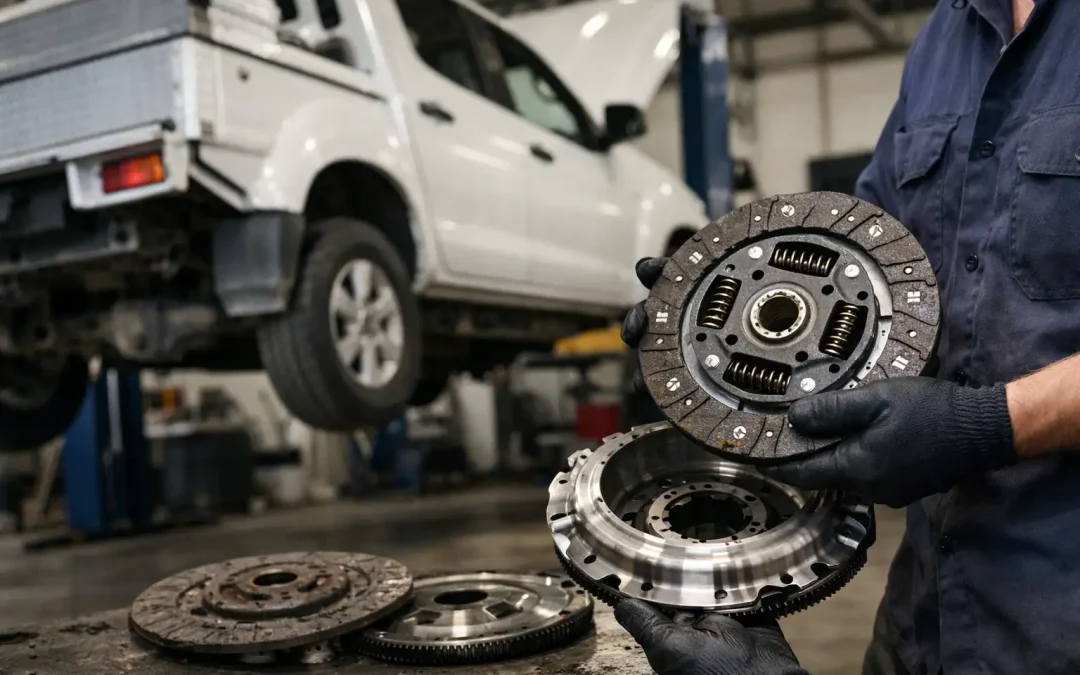
Once the gearbox is removed, the real condition becomes clear. In this example, the clutch friction material was substantially worn and heat marks were visible on the pressure plate and flywheel surface. The release bearing was also nearing the end of its useful life. Fitting only a new clutch disc would have been a false economy. The gearbox labour is the major part of the job, so worn supporting parts need to be assessed while access is available.
The flywheel requires close attention as well. Some flywheels can be machined if they remain within the manufacturer’s specifications and have no serious heat damage or cracking. Others, particularly certain dual-mass flywheels, must be replaced if they are outside tolerance. This is one area where a cheap shortcut can cause shudder, noise or an early repeat repair.
What was included in this work ute clutch replacement
For this ute, the sensible repair was a complete clutch kit matched to its workload. That included the clutch disc, pressure plate and release bearing, along with inspection of the clutch fork, pivot points, hydraulic operation and gearbox input area. The flywheel was measured and assessed before the final recommendation was made.
A complete job also means checking items that can create trouble later, including the rear engine seal area, gearbox seals where relevant, gearbox mounts and any signs of oil contamination. If oil has reached the clutch, simply fitting new friction material will not last. The source of the leak must be repaired first.
The owner was given straight answers on the condition of the parts and the options available. For a ute that works for a living, the decision is usually based on more than the lowest upfront price. A quality replacement component that suits towing and regular load carrying can make better financial sense than being off the road again sooner than expected.
Standard replacement or heavy-duty clutch?
Not every work ute needs a heavy-duty clutch. If the vehicle spends most of its time unladen on local roads and only occasionally tows a light trailer, a quality standard-equivalent clutch may be the best match. It should provide dependable operation without unnecessarily changing pedal feel or driveability.
The calculation changes when a ute is regularly towing, carrying heavy tools, fitted with larger tyres or used for touring and four-wheel driving. Extra vehicle weight and low-speed manoeuvring place more heat into the clutch. Reversing a loaded trailer, climbing steep tracks and repeated stop-start work can all shorten the life of a clutch that is not designed for that use.
A heavy-duty option can provide greater holding capacity and durability, but it needs to be selected carefully. More clamping force can sometimes make the pedal firmer. The goal is not to fit the toughest part on the shelf. It is to fit the right clutch for the vehicle, the engine’s torque and the way the owner actually uses it.
Why the flywheel and hydraulics cannot be overlooked
A clutch is a system, not a single part. The clutch disc transfers drive, the pressure plate clamps it, the flywheel provides the working surface, and the release and hydraulic components allow the driver to disengage it. A fault in one area can affect the whole system.
In this example, the flywheel had heat spotting but remained suitable after assessment and the approved machine work. Had it been left with an uneven or damaged surface, the new clutch could have shuddered on take-off or worn unevenly. The hydraulic system was also checked for correct operation, because a weak master or slave cylinder can cause difficult gear changes and leave a driver thinking the new clutch is at fault.
This attention to the surrounding components is what separates a proper clutch repair from a parts swap. It gives the replacement clutch the best chance of delivering smooth engagement and reliable service over the long term.
The fitting process and final checks
After the approved parts and flywheel work were ready, the gearbox was removed and the old components were inspected against the diagnosis. The new clutch assembly was installed to specification, with all mating surfaces prepared correctly and bolts tightened to the required settings. The release system was checked, and the gearbox was refitted with attention to mounts, fasteners and connections.
The final stage is just as important as the first. The clutch pedal is checked for proper operation, the hydraulic system is tested and the ute is road tested. Gear selection should be clean, take-off should be smooth and the clutch should hold under acceleration without slip. Any noise or vibration is investigated before the vehicle is handed back.
For a work vehicle, clear communication also matters. The owner needs to know what was found, what was replaced and whether there are any maintenance items to plan for. There should be no pressure and no mystery around the work completed.
How to help a new clutch last
A new clutch is built to work, but a few habits can greatly affect its lifespan. Avoid resting your foot on the clutch pedal while driving, as even slight pressure can cause unnecessary wear. At lights, select neutral rather than holding the ute in gear with the pedal down for long periods.
When towing or carrying a load, use low range where appropriate rather than slipping the clutch to control speed on rough ground or steep inclines. Give the ute enough revs to move away cleanly, but do not use excessive revs and prolonged clutch slip to force a heavy load moving. If you smell a burning clutch, stop when safe and let it cool rather than continuing to work it hard.
Most importantly, act early when the signs appear. A clutch that slips occasionally under load will not repair itself. Continuing to drive can damage the flywheel and turn a manageable job into a more costly one.
For drivers in Albury Wodonga, a work ute is often more than transport. It is how the day gets done. If your clutch is slipping, shuddering or making gear changes difficult, getting a specialist diagnosis from Albury Brake and Clutch Centre can help you make a clear decision and get back to reliable work without guesswork.