


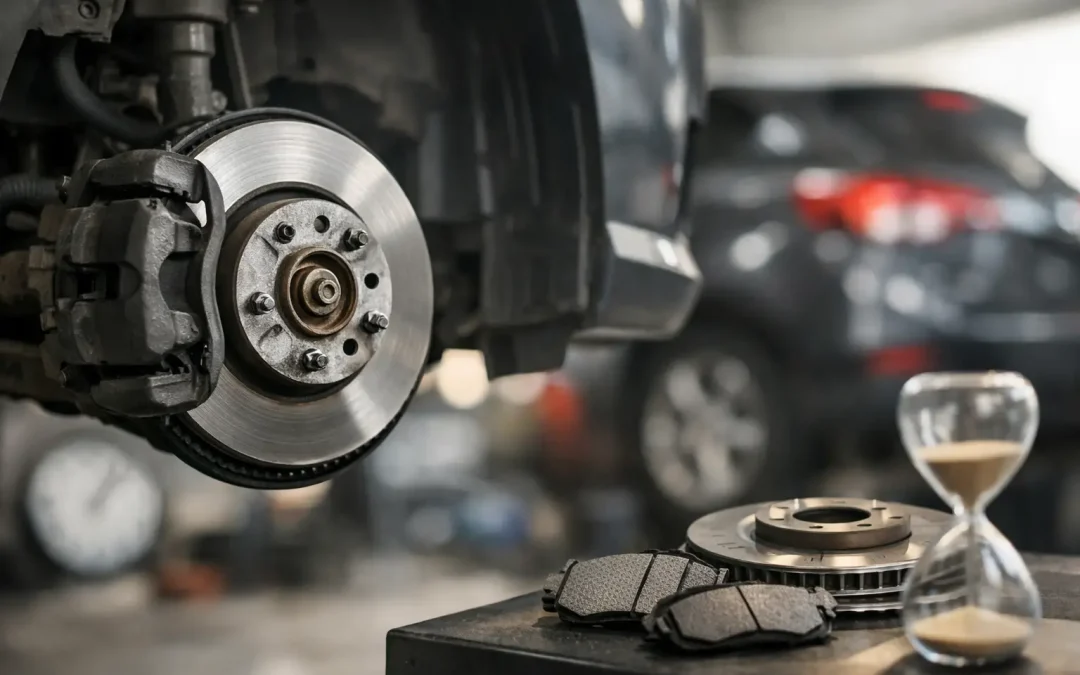
You usually only think about your brakes when something feels off – a squeal at the lights, a longer stopping distance on the bypass, or a pedal that suddenly feels different under your foot. So, how long do brakes last? The honest answer is that it depends on the vehicle, the parts fitted, and how you drive, but most brake pads last somewhere between 30,000 and 70,000 kilometres.
That range is wide for a reason. Brake life is not a fixed number, and anyone who gives you one without looking at the car is guessing. A commuter hatchback doing mostly highway kilometres will wear brakes very differently from a 4×4 towing a van through the hills, or a family SUV doing school runs and stop-start traffic around Albury-Wodonga.
How long do brakes last in real-world driving?
For most everyday drivers, front brake pads wear faster than rear pads because the front brakes do more of the stopping. Front pads may need replacing from around 30,000 to 60,000 kilometres, while rear pads can often last longer. Brake discs or rotors usually outlast the pads, but not always. If they are undersize, heat-affected, cracked, grooved, or warped, they may need machining or replacement sooner.
The key point is this – brake parts do not all wear at the same rate. Pads, rotors, calipers, brake fluid and hardware all play a part in how the system performs. You can have plenty of pad material left and still have a brake problem if the rotors are damaged or the caliper is not working properly.
That is why proper diagnosis matters. A quick look through the wheel is not the same as a full brake inspection.
What affects how long your brakes last?
Driving style is one of the biggest factors. If you brake late and hard, your pads and rotors will wear faster. If you leave more room, coast earlier, and brake smoothly, brake life generally improves.
Where you drive matters too. City traffic is harder on brakes than open-road driving because the system is working constantly. Steep descents, roundabouts, traffic lights and heavy congestion all add wear. Regional drivers often do a mix of highway and town driving, so the actual brake life can vary even from one household to the next.
Vehicle size and load also make a difference. Larger SUVs, utes and 4x4s carry more weight, and once you add tools, passengers, a canopy, bigger tyres, a trailer or caravan, the brakes have to work harder again. If your vehicle has been set up for towing or touring, standard brake parts may wear faster than expected unless the system is matched to the job.
Part quality counts as well. Not all brake parts are made to the same standard. Cheap pads can wear quickly, create noise, dust heavily, or put extra strain on the rotors. Quality components usually give better consistency, better heat control and better long-term value, even if the upfront price is higher.
Then there is maintenance. Old brake fluid, sticking calipers, seized slide pins and worn hardware can all shorten brake life. Sometimes the pad itself is not the original problem – it is just the part wearing out because something else in the system has been ignored.
The signs your brakes may be wearing out
Brakes rarely fail without warning. More often, they give you signs that something needs attention.
Squealing is one of the most common. Sometimes that is a wear indicator telling you the pads are low. Sometimes it is caused by dust, glazing, poor-quality parts or rotor condition. Grinding is more serious and can mean the pad material is gone and metal is contacting the rotor.
A longer stopping distance is another warning sign, especially if it appears gradually and you have got used to it without realising. If the pedal feels soft, sinks lower than normal, or the vehicle pulls to one side under braking, do not leave it. Those symptoms can point to uneven brake wear, hydraulic issues or seized components.
Vibration through the pedal or steering wheel can suggest rotor problems, although it is not always the rotor itself. What matters is getting the fault diagnosed properly rather than replacing parts based on guesswork.
Brake pads, rotors and fluid all have different lifespans
When people ask how long brakes last, they are usually asking about brake pads. But the full brake system includes more than that.
Brake pads are the normal wear item and are designed to be replaced as they wear down. Rotors may last through more than one set of pads, but only if they remain within specification and are in good condition. If they are too thin or damaged, fitting new pads alone is not the right repair.
Brake fluid does not wear out in the same way, but it does absorb moisture over time. That reduces performance and can contribute to corrosion inside the system. Changing brake fluid at the right interval helps protect the parts you cannot easily see and keeps pedal feel more consistent.
Calipers, hoses and hardware can also age or seize. That is one reason a proper service is about more than simply swapping out old pads.
Why some brakes wear out much sooner than expected
If your brakes only lasted 20,000 kilometres, that is not always normal wear. It may be the result of towing, heavy loads, steep terrain, aggressive driving or low-quality parts. It can also point to a fault in the system.
A sticking caliper can keep a pad dragging on the rotor even when you are off the pedal. Worn suspension can change how the vehicle behaves under braking. Poor bedding-in after a brake job can also affect pad and rotor performance.
For 4x4s and work utes, brake wear can climb quickly once the vehicle is carrying more weight than the factory setup was designed for day in, day out. Bigger tyres and increased GVM setups often need more stopping power and better heat management. In those cases, a brake upgrade can make more sense than repeatedly replacing standard parts.
Can you make your brakes last longer?
Yes, but not by cutting corners. The best way to get longer life from your brakes is to keep the whole system in good order.
Smooth driving helps. So does giving yourself more room in traffic and using engine braking sensibly on long descents. Keeping up with inspections matters too, because catching a seized slide pin or worn rotor early is cheaper than replacing extra parts later.
It also pays to fit the right parts for how the vehicle is used. A car doing school runs has different brake demands from a ute towing a trailer every weekend. Matching the parts to the job usually gives better life, better feel and fewer comebacks.
When should you get your brakes checked?
If you notice noise, vibration, pulling, poor stopping or a change in pedal feel, book it in. If you are not sure when the brakes were last inspected, that is reason enough for a check. Waiting until the brakes are obviously bad often turns a smaller job into a larger one.
Regular inspections are especially important before a road trip, before towing, or if you have recently bought a used vehicle and do not know the condition of the braking system. A proper inspection gives you a clear picture of what is worn, what is still serviceable, and what can wait.
At Albury Brake and Clutch Centre, that means straight answers and no pressure – just a proper look at what the vehicle actually needs.
So, how long do brakes last?
In most cars, brake pads last roughly 30,000 to 70,000 kilometres, but that figure is only a starting point. The real answer depends on the way the vehicle is driven, the loads it carries, the roads it sees, and the quality of the parts and servicing behind it.
If your brakes are making noise or the car just does not feel right when you stop, trust that instinct. Brakes are not a system to guess at. A proper inspection now is usually cheaper, safer and a lot less stressful than waiting for the problem to get worse.